The winters here in Michigan are pretty long and cold. The cold starts in late November and doesn't leave until the spring, sometimes not even til May. For someone who's interested in herps, this is a long hiatus followed by an all too quick field season. So, in order to make it through the long winter months, I've decided to take up winter birding. Michigan is a pretty popular destination for birding, due to its large migrations during the spring, fall, and winter. Plus, it has a endangered bird that breeds almost exclusively here. But in the winter, we sometimes get visitors from the far north. I've become increasingly interested in some of the owls which occasionally overwinter in Michigan during irruptive years. So what is irruption? According to the
Cornell Lab of Ornithology, "Irruptive migration occurs in species that respond to irregular changes
in food supplies. For example, the availability of seeds and buds
consumed by species such as redpolls and Pine Grosbeaks can vary
substantially from year-to-year and from location-to-location. In some
years the food supplies in the north may be adequate and the birds
remain in the northern forests during the winter. In other years the
food supplies are low and the birds move south or to other locations
outside of their typical range. These movements outside their normal
range are called irruptions...While not in the seed and berry category, some
raptors also exhibit irruptive behavior. Northern
owls such as the Great Gray Owl and Snowy Owl sometimes exhibit this
behavior. Most remain in their Canadian homes throughout the winter. In
irruptive years, presumable as the result of poor food supplies, large
numbers of these species may move into the northern United States." This means that Michigan can be a prime destination for winter birding.
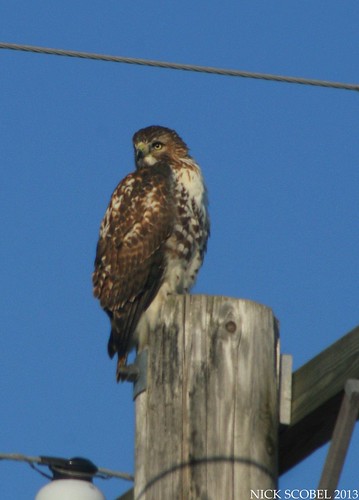
eBird.org has a fantastic database where birders submit their sightings. It can be filtered by species and date of sighting. I decided to look up southeast Michigan and see if there were any local sightings. There were two within a fifteen minute drive of my house. So as a newbie birder, I decided to bundle up, grab my Sibley's and binoculars and head out in search of an irruptive Snowy Owl. My first stop was a series of large agricultural fields. In the far north, snowies inhabit tundra habitat. The tundra consists of large open areas with sparse, low vegetation where the owls can perch on hills or boulders to hunt. Open habitats such as agricultural fields act as artificial tundra during the winter months, and snowies often utilize these types of areas during irruptive years. As I turned down a road bordering an agricultural field, I noticed the first of many red-tailed hawks I would see on this day.
Red-tailed Hawk - Buteo jamaicensis
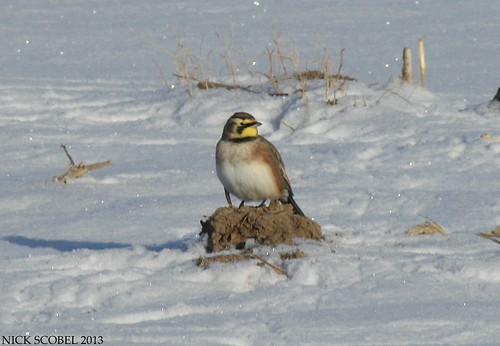
The bird only sat for a few moments before flying off. I noticed several more utilizing power lines throughout the rest of the day. I also saw a Northern Harrier (Circus cyaneus) through my binocs from about 200 yards away, as well as a few Cooper's Hawks (Accipiter cooperii) in the scattered woodlots around the periphery of the agricultural fields. There were lots of small birds like starlings, finches, and dark-eyed juncos along the hedgerows of the fields. I then noticed some larger, colorful birds hopping around in the agricultural photos, they turned out to be horned larks.
Horned Lark - Eremophila alpestris
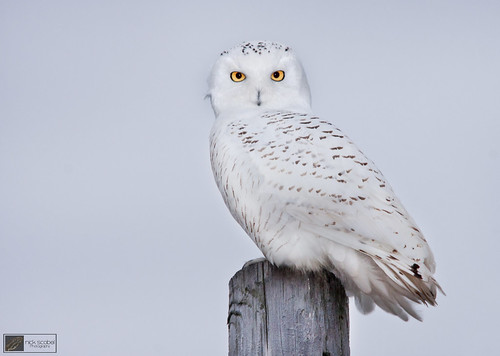
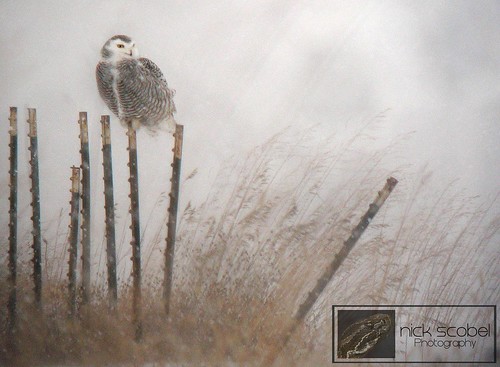
I spent another forty-five minutes or so looking for any owls to no avail before moving on to a different area. Like agricultural fields, airfields feature a wide expanses of land with sparse vegetation just like the tundra. I decided to drive a back road which borders the periphery of a large airfield in hopes of seeing the owl that had been recorded in the area about a week earlier. The sun had disappeared, the wind had picked up, and a squall of snow had begin to fall. I felt like it would be difficult to spot a large white owl on the snow covered ground, so I was hoping I would be fortunate enough to spot one on a fencepost or power line. As I came around a corner, a large white shape caught my eyes through the heavy snow. There, sitting atop an old fencepost, was a Snowy Owl.
 |
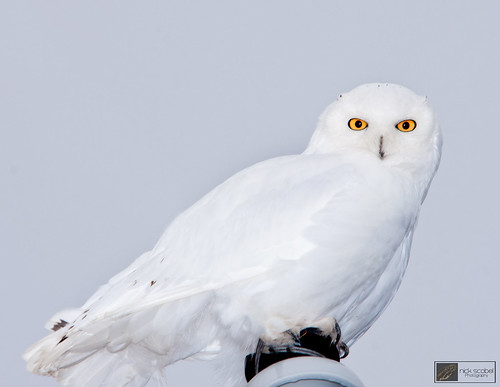
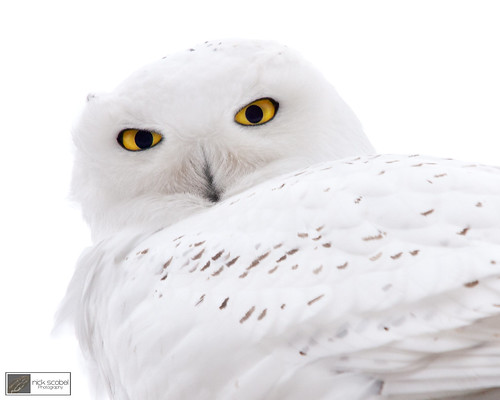
| Snowy Owl (Bubo scandiacus), Wayne County, MI |
I was so excited that I put my car into a bit of a skid when I hit the breaks. I turned around, pulled off the side of the road and grabbed my binoculars. Within a few minutes, another car pulled up. A woman emerged and asked, "Do you see something I don't?" I told her to look out to the fence post, she immediately pulled her car behind me and brought out a large Swarovski spotting scope. She was kind enough to let me fire a few photos of the owl through her spotting scope. The result came out fairly nice, considering the method of shooting, the heavy snow, and the fact that the owl was more than 100 yards away. Several more birders arrived in the coming minutes and we spent about a half an hour observing the bird before it took off and flew directly overhead. It was an awesome experience and I'd like to thank the birders for their knowledge and great company. I may have been bitten by the birding bug, stay tuned for more. And, Merry Christmas everyone!