Sunday, July 25, 2010

Eastern Box Turtle Conservation

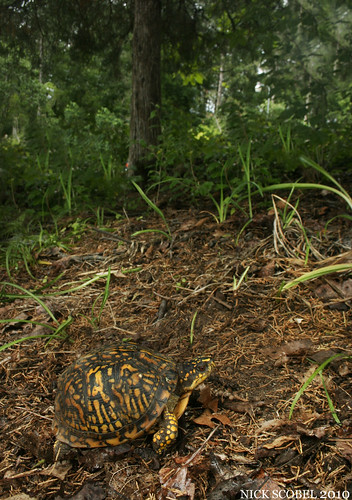
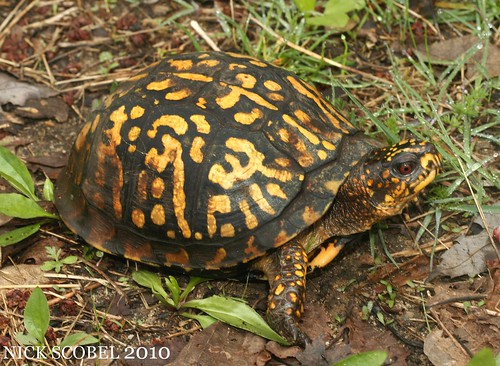
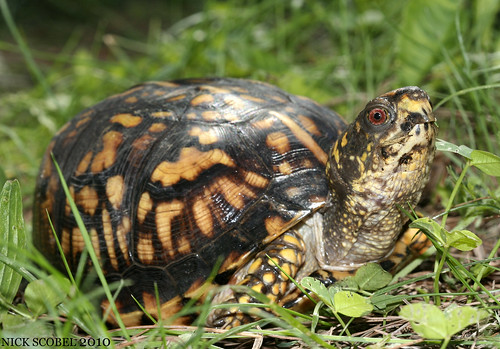
Of all Michigan turtles, the Eastern Box Turtle is by far the most charismatic. A Species of Special Concern in Michigan, this species has declined drastically from its former distribution in the state. Nest predation, habitat fragmentation, road mortality, and illegal collection are the catalysts for the decline of the Eastern Box Turtle. Today, populations persist in pockets where grassland and mature woodlands still exist without fragmentation. Michigan individuals are often brightly colored with yellow or orange and have much broader carapaces than individuals of the same species which exist farther south in the range. This summer, my internship has allowed me to get direct involvement with the study and management of this species through captive head starting programs and aiding in telemetry studies.


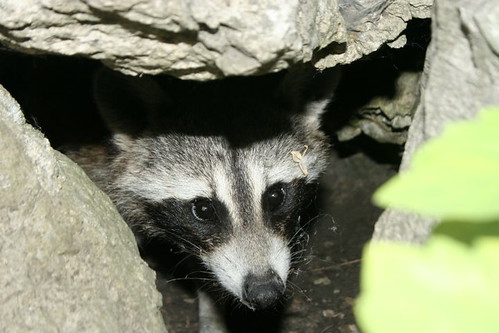
Even today, nest predation and road mortality are the most significant threats to the longterm survival of this species in Michigan. Raccoons are estimated to occupy 700-800% of their original population numbers at the turn of the century. This explosion in population is due to the species ability to adapt the modern urban landscape and capitlize on being an opportunist when it comes to feeding. One behavior that the raccoon has learned is rading turtle nests which have been freshly laid. This has gotten to the point that usually the only turtle nests one can find is a predated nest by racoons. Roads are also an issue. Box Turtle habitat is often fragmented due to development and roads and in areas where populations exist, this species is extremely vulnerable to being killed moving from one patch of habitat to another.

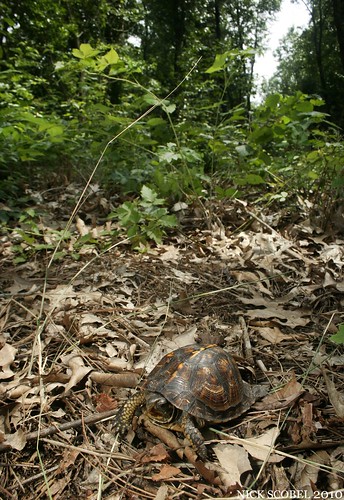
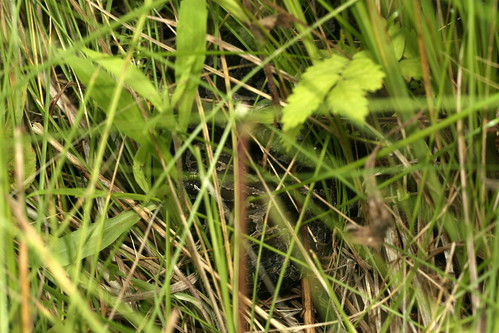
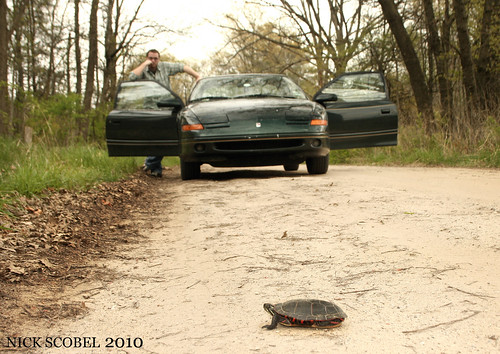
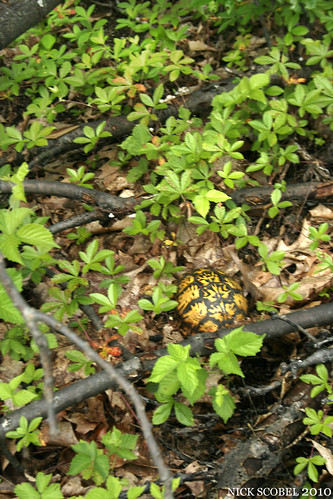
Farther south in their range, Box Turtles are traditionally known as a woodland species. But in Michigan, they prefer a mosaic of community types. Michigan Turtles often are found along woodland edges in grasslands but they occasionally wander into wetlands such as fens. They are often found in some sort of cover and are rarely out in the open except after summer rainstorms. Here's an example of a Box Turtle as found, see if you can spot her.
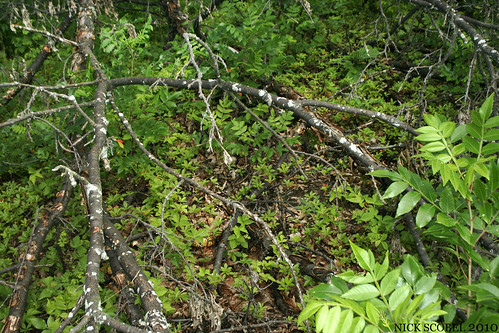
See her?
Box Turtles have a wide diet which includes worms, insects, plants, berries, and fungi. In the late summer when wildberries fruit out and drop to the ground, Box Turtles can often be found concentrated under or around large berry patches. Sometimes the evidence of Box Turtles is hard to miss.
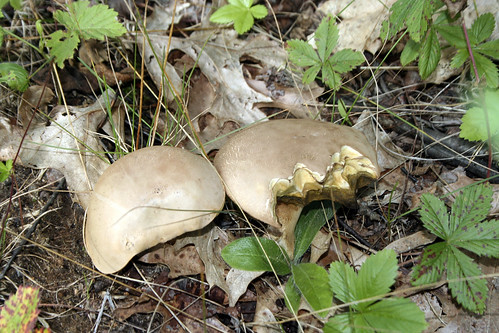
These mushrooms bare the unmistakable beak marks from a foraging Eastern Box Turtle. 
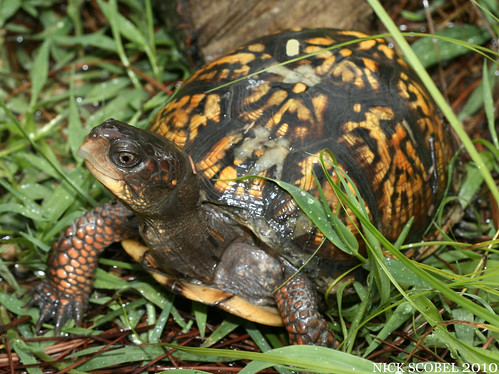

The culprit as found a few feet away. Earlier this summer we were lucky enough to aid in a few telemetry studies on EBTs in southeast & southwest Michigan. Studies such as these which evaluate habitat use, home range size, diet, and other factors are critical for the continued understanding of the life history of the species which in turn helps land managers properly manage habitat where these turtles exist of have the potential to exist.

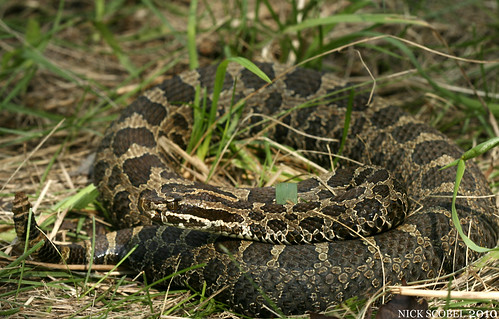
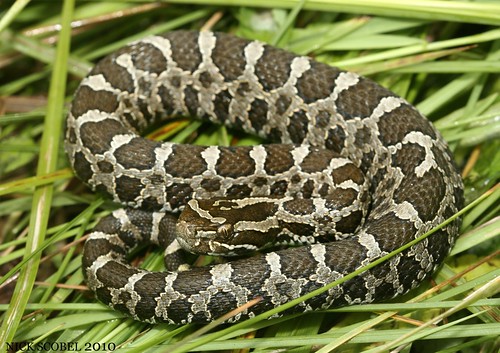
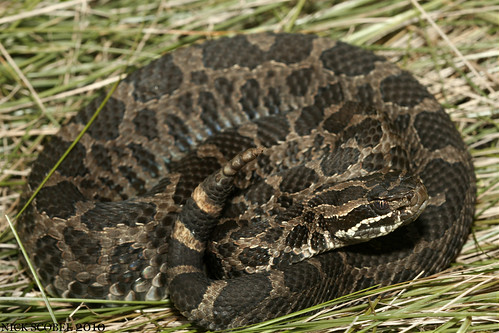
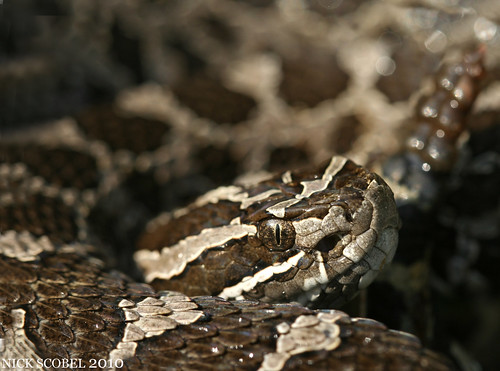
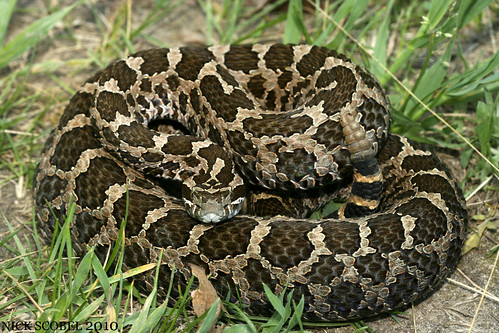
Eastern Massasauga Observations

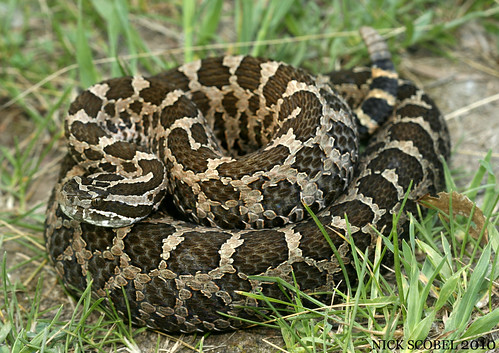
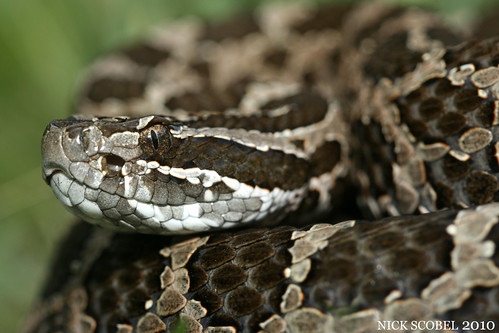
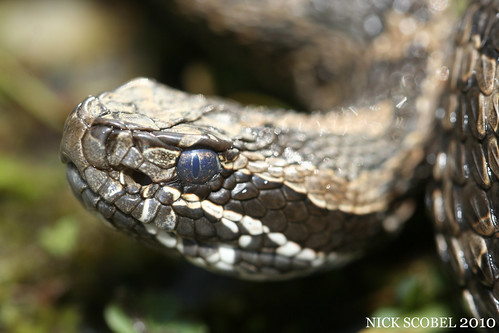
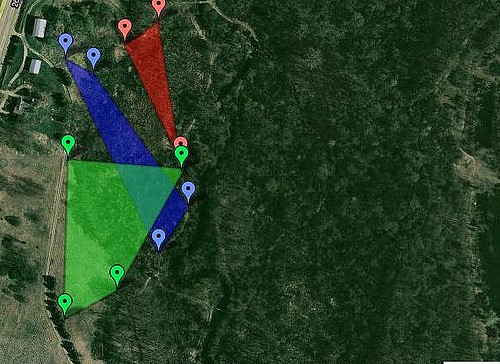
I've been away from here for awhile, mostly because a full time internship has taken up the majority of my time. However, I've managed to get some field time with the limited free time I've got. I've been focusing on a few different species in the field this spring and summer and I'm attempting to compile data for the Michigan Herp Atlas and future research projects. I'll get to the turtles later on, but for now I'll talk about rattlesnakes. I'll spare the grief of giving the usual fluff about Eastern Massasauga Rattlesnakes; how they're shy, secretive, etc. As I further my studies at CMU and continue to collect casual observations on these snakes, I've become more and more interested in their ecology, behavior, and so on. Everytime I encounter a rattlesnake in Michigan, I take GPS coordinates and other data. Since 2006, I've kept a detail photo record of individual rattlesnakes I've encountered and its allowed me to recognize certain snakes at a few different sites by looking at blotch count and unique head patterning. If I recognize a snake, I'm able to add the point into GIS software under that specific snake's data set. Three observations or more of the same individual allows me to create a polygon overlay which is a loose idea of what that snake's home range is. Now, this is a rough estimate and not quantifiable by statistical analyses, however it does give me and idea of what areas a specific rattlesnake is utilizing at any given field site.


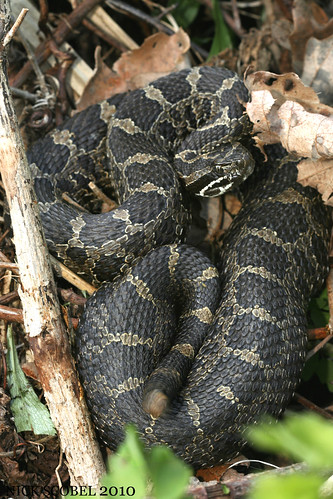
Thus far, I've made 34 observations on 30 different rattlesnakes in the 2010 field season. Two of these individuals were snakes I'd seen in the past few years and helped aid in my analysis of a few separate sites. In the early part of May, my girlfriend and I took a walk on a trail in the early morning and managed to encounter two adult rattlesnakes, both of which appeared to be gravid females. One was in shed while the other was a very dark coloration, almost borderline melanistic (more on that later).


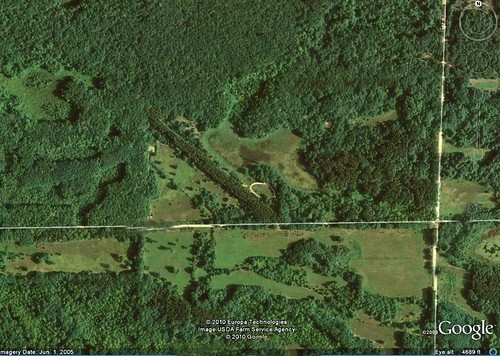
To give a rough idea of what I'm talking about, here's a aerial photo with a few polygons on it. Each time I've encountered a snake I've seen before, I enter the GPS coordinates of the spot it was found at. This automatically adjusts the shape of the polygon to the minimum area this snake has covered. It's cool to see overlaps in the home ranges of these snakes. Here's three individuals that I've seen over the past few seasons.

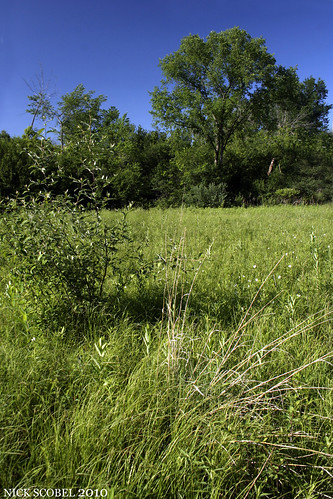
GIS analysis and mapping has aided in identifying clusters of data points which in turn provide an idea of activity centers by looking at these points overlayed on an aerial photograph. With the help of this, I've been able to identify significant sites where rattlesnakes seem to concentrate and different times of year. One area of particular interest is a small meadow which is bordered by a fen on one side and stream on the other. This site appears to be a significant site for gravid females & neonates.


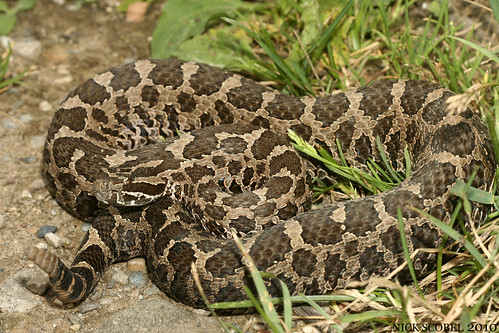
Since June, I've observed three gravid females mulitple times in this small meadow as well as a handful of yearlings. Here's some shots of gravid females & yearlings from the past few months in the small meadow.


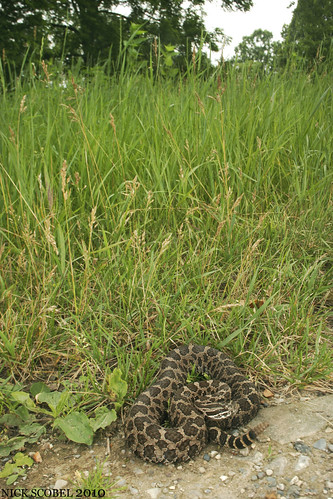
I've also been monitoring a large grassland complex at another site where I've observed at least four different snakes. Most have been found basking in open grassy patches in the morning while others have been found tight to shrub cover in the late afternoon. I've even had instances where I've found snakes basking right along the grassland edges on trails or two-tracks that bisect the grassland.

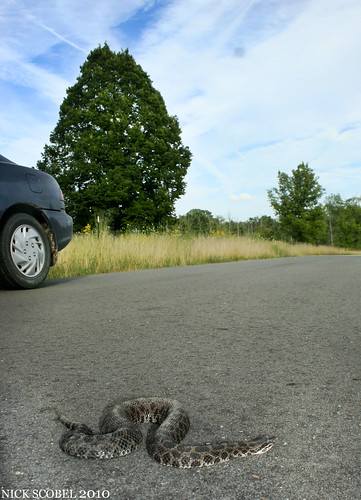
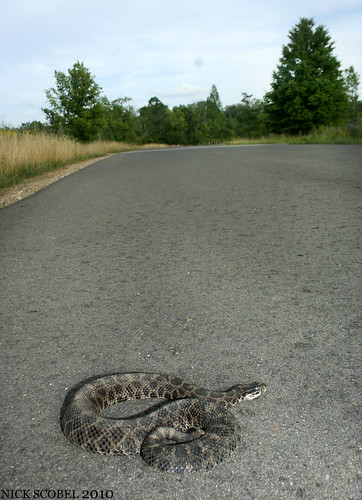
Most of the time these snakes avoid mowed grass or roads. But occasionally they do wander onto these areas. Most people will never encounter an Eastern Massasauga on a roadway. But in parks, preserves, or state game areas where they occur, it is mindful to keep a watchful eye in the unlikely event that one crosses a road.


Until next time...

Tuesday, May 4, 2010

Michigan Pine Barrens

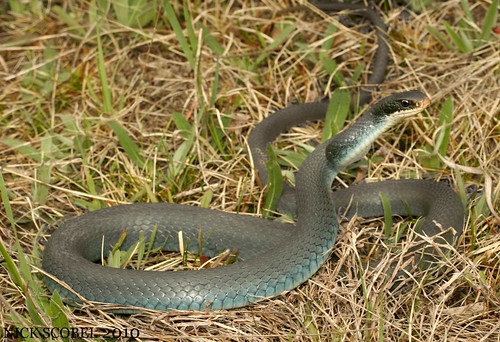
As you move from east to west across Michigan lower peninsula, the soil changes to a much more sandy type in the west. These sandy soils give rise to different plant communities and in turn, many different herp species. A favorite vegetation type of these soils are pines. Many times these stands of pines become open sandy areas with a few scattered trees, this habitat is often known as pine barren. The best example of pine barrens exist is New Jersey, where thousands or square miles of this habitat exists. In Michigan, pine barrens or sandy pine flatwoods occur mostly in the west half of the state. However, across the central part of the state, these habitats begin to show themselves and there are some great examples of this community in western Isabella County, a mere twenty miles from CMU's campus. I'd never seen a racer in Isabella County, so a friend and I decided to investigate a nice pine barren habitat. Within a few minutes this beauty made an appearance.
 Blue Racer - Coluber constrictor foxii

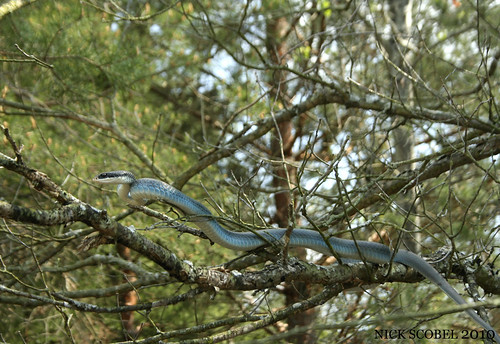
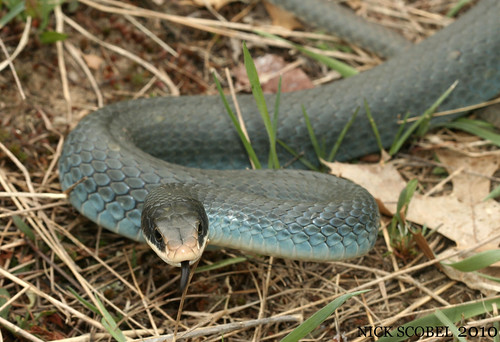
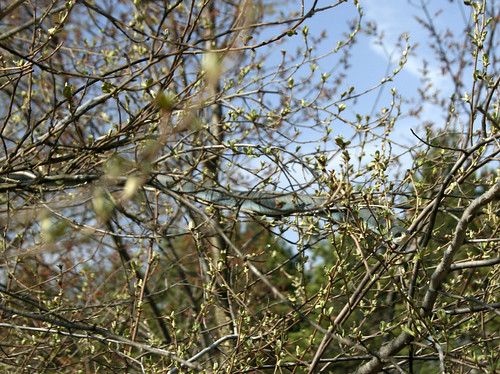
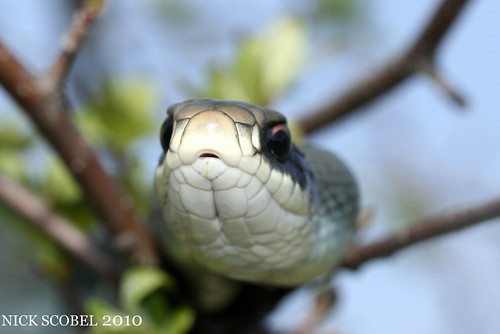
This large individual had one of the most vivid blue colorations I've ever seen on an individual of this species. It was orginally out cruising before we crossed its path and it immediately proceeded to dart up this nearby Red Pine. Eastern White Pine; Michigan's state tree, and Red Pine dominate this particular site. There are also a few low lying shrubs in the area.


We watched the snake for a few minutes as it sat in the tree, observing our every move. Eventually it lost interest and began to climb much higher into the Red Pine, I grabbed a few parting shots as we moved on.


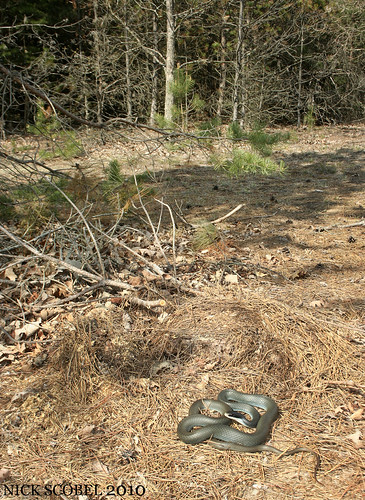
As we moved through the area, we kept our eyes peeled for another denizen of these sandy soil habitats, the Eastern Hognose Snake. This species is a toad lover, and its spends most of its time using its upturned rostrum to dig for its favorite food. We didn't happen to come across any Hogs, but we did manage to bump into another large Blue Racer out basking in the pine barren.


Blue Racer - Coluber constrictor foxii

After having good success at our first site, we decided to head south into Montcalm County and stop at another open pineland with sandy soil in hopes of turning up and Eastern Hognose. Along the way we bumped into two of these crossing the road.

Midland Painted Turtle - Chrysemys picta marginata

We checked our sandy pine area with no luck, but did score this racer crossing the road on our way out of the area in Montcalm County.

Blue Racer - Coluber constrictor foxii

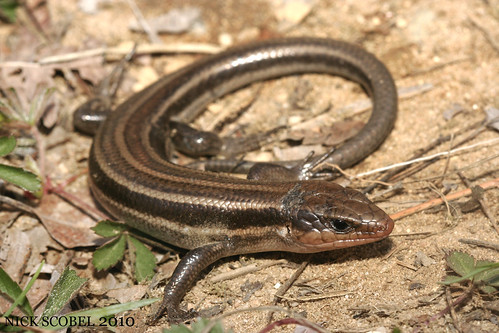
Our final stop took us to the northeast in a tract of the Gladwin State Forest. This site is a clearcut area with lots of debris and is home to a particular species of Lacertilian. After flipping a few logs and lifting some bark, we found our quarry.


Five-lined Skink - Plestiodon fasciatus 

A day trip around the central areas of the state produced some awesome finds, and I plan on spending more time in those sandy soils as the year progresses...

Monday, April 26, 2010

Eastern Box Turtle

After a night of heavy thunderstorms, a friend and I headed out to an area in southeast Michigan which is home to the Eastern Box Turtle, a species of special concern in Michigan. This road winds through an area of interesting topography for Michigan, it looks like an area which would be more common in southern Ohio or Kentucky. The roads cut through varying habitats which include fen, prairie, and upland deciduous forest. This varying habitat gives Box Turtles a great arrary of habitat corridors that they can utilize throughout the season, plus the road has very little traffic which decreases the likelihood for road mortality at this particular site.


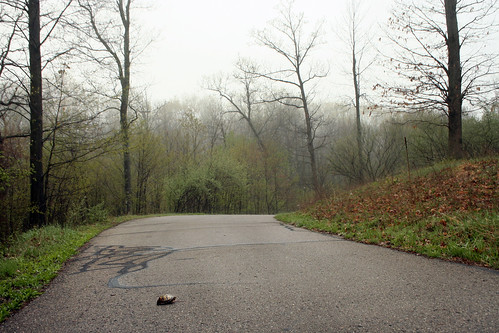
After rainstorms the night previous, the morning air was humid and fog covered the area. We figured that since EBTs seem to love coming out after summer rainstorms to pick off earthworms, we felt a humid morning was worth a shot. Sure enough, it was a good decision. As we came around a switchback, we both silmulataneously yelled, "Box Turtle!" as we noticed this sight.


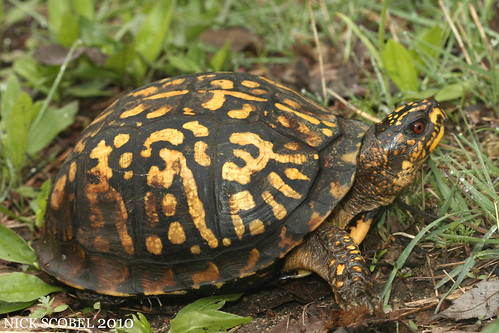
It was a gorgeous adult female making her away from one patch of habitat to another. She was fairly large and her growth rings on each scute were quite smoothed out, indicated this was one old girl. We didn't bother her too much, only snapping a few photos as she wandered off the road into the woods. Eastern Box Turtles are a species of concern here in Michigan, and most of the known populations occur in the western half of the lower Peninsula, so to see a healthy population here in southeast Michigan is encouraging. I can only hope this species will persist in this area for years to come.


Eastern Box Turtle - Terrapene carolina carolina

Friday, April 23, 2010

April Blues!

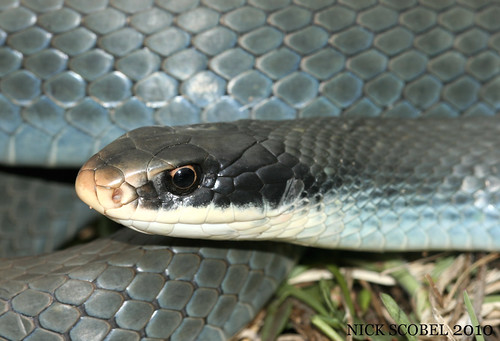
Sometimes in order to find something, you've got to do a bit of research. I've always found that the more you understand about a species, the better chance you'll have of putting yourself into a situation to find it. There's a particular snake species that has given me a bit of fit here in Michigan, and that snake is the Blue Racer. It's considered to be a relatively common snake, but they seem to be very locally distributed. I've seen a handful, but mostly I encounter them dead on roads in the summer. So this spring I became determined to find some racers before the cover got too thick. I had heard reports and rumors of these snakes inhabiting some areas in Montcalm County, which is directly south of where CMU lies in Isabella County. So after a bit of research, I was able to zone in on a few areas including this one.


This particular set of fields intrigued me because of the amount of hedgerows and adjacent woodlands. Blue Racers are big active snakes, and although they prefer open areas, they often work transition zone areas because it gives them access to cover and open space, aiding in thermoregulatuon. So after scouting some of these areas, a good friend and I headed out one day to see what these fields held, in hopes we would find our target.


Upon arrival, I was pleased to see the few clumps of isolated shrubs and trees. The area looked picture perfect for racers. No more than ten minutes after stepping into the first field we got to, we were greeted with this sight.


We were able to snag both individuals out of the small tree, possibly a mating pair. Each measured out over the four foot range, big snakes. I've seen racers elsewhere in Florida, Indiana, Ohio, Illinois and the Michigan variety are much more heavy bodied. After taking a few bites, we were able to shoot some pictures of these magnificent snakes.


Blue Racer - Coluber constrictor foxii


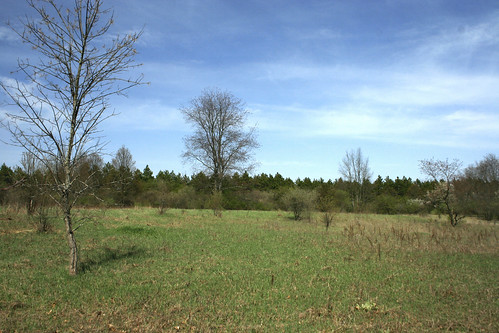
The next week, my friend Curtis Hart drove up from southern Michigan to join me for a day. After knocking out a few targets, we scouted some other fields where I had seen racers a few days before. Here's the field we walked on this particular afternoon.


 Not long after entering the field, Curtis called out that he had found one. Once again, this snake was found stretched out in a low lying shrub.


Blue Racer - Coluber constrictor foxii

Not long after spending time with this first snake. I heard another moving about along a hedgeline and noticed a head periscoping from the long grass. It was nice to cash in on a spot that I had scouted and done some research on. Target acquired and apprehended.