Sunday, February 26, 2012

Fungal Infection Poses a New Threat to the Eastern Massasauga

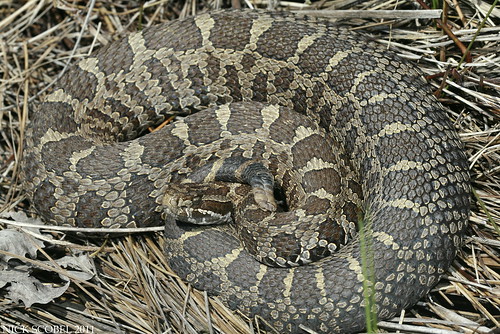
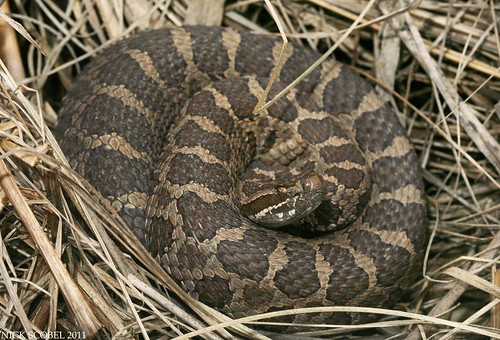
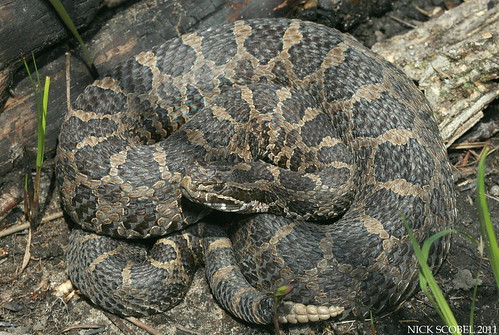
There's plenty of attributing factors as to why the Eastern Massasauga has declined across its range. However, a new threat has emerged in at least one population that has caused a lot of concern among biologists and conservationists alike. A fungus known as Chrysosporium has caused the death of at least three rattlesnakes in an isolated Illinois population, which you can read about here via the University of Illinois. The infected snakes exhibited grotesque facial disfigurations and lesions due to infection by the fungus and eventually died due to complications from the infection.


Chrysosporium is a prevalent infection within the pet trade and is a common infection that effects lizards, snakes, and sometimes humans. However, this is the first time that an infection from the fungus has been documented in a population of free ranging snakes. But similarly infections have been documented in Timber Rattlesnakes in the northeastern United States. It is concerning that this pathogen has emerged in snakes as different type of fungus like chytrid fungus have caused massive population declines in amphibians.


However, at the end of the day is unclear as to what the emergence of this infection has in store for other Massasauga populations. The affected population is extremely small and isolated and suffers from a high frequency of inbreeding events. It's possible that this population was more susceptible to infectious disease because of immunosupression due to poor genetic diversity and healthier populations may have nothing to worry about for the time being. But in any case further research is needed to better understand this pathogen and its effect on snake populations, including the Eastern Massasauga.

Thursday, February 23, 2012

Michigan's Gummy Lizards: Part Two

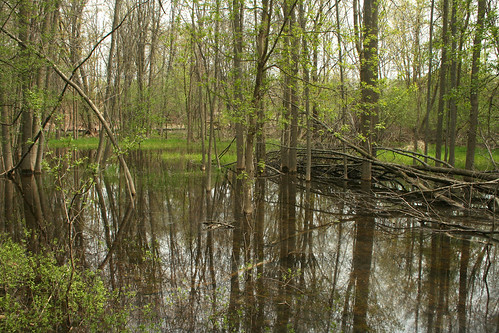
With the the Plethodontids out of the way, the second group of salamanders which inhabit Michigan come to the forefront. This group of salamanders is known as the Ambystomatids; the Mole salamanders. Mole salamanders spend much of their time underground in root systems, rodent burrows, and other tunnels which give them their name. Occasionally they may be found under logs, leaf litter, and other debris on the forest floor after heavy rains but are most usually seen the during breeding season in early spring. Mole salamanders utilize temporary, seasonal pools known as vernal (ephemeral) pools for breeding purposes and can sometimes be found in huge numbers in these areas on warm, rainy nights in the early spring. Michigan is home to five species of Mole salamander which come in a variety of shapes and colors.

Spotted Salamander
Ambystoma maculatum

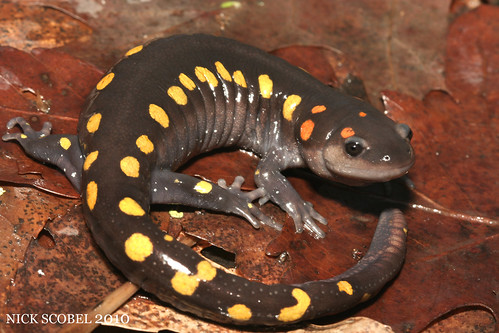
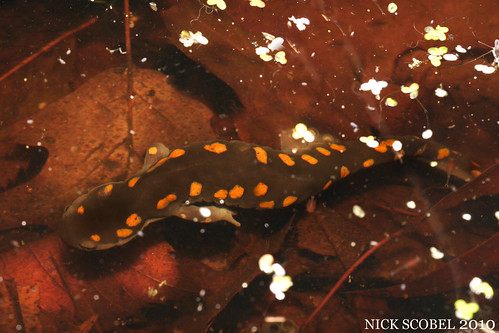
This brightly marked species is easily distinguishable from most of Michigan's salamander species in that is exhibits a dark background with two rows of bright orange or yellow spots down its dorsum. The number of spots may vary greatly among individuals may have few but very distinct spots, while others may have many which are smaller in size. In Michigan, some individuals exhibit orange spots on the head while the spots on the body are much more yellow in coloration. Although it is a common species in Michigan, the Spotted Salamander is not usually observed outside of the breeding season it early spring. At this time of the year, spotted salamanders migrate to temporary woodland pools known as vernal pools to breed.


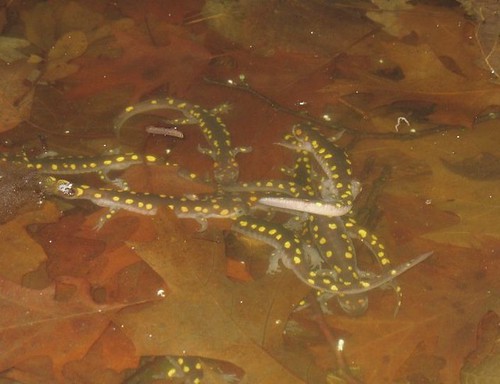
Migration occurs on warm, rainy nights in late March or early April. Salamander emerge and migrate to vernal pools where males often congregate in huge numbers around a single female and perform a "tail dance" in the water to impress the female. Each male drops several packets of sperm known as a spermatophore which contains all the genetic material to pass on to the next generation.


A female will take a single spermatophore into her cloaca, which fertilizes the eggs which she is carrying. After a day or two the eggs will be fully fertilized and the female will remain in the pool until she lays her eggs. Spotted Salamander females often attach egg masses to twigs, leaf litter, or other material within the vernal pool as the female which is shown below ovidepositing her eggs to some leaf litter.


The larva hatch and spend the majority of the year in the pool until they metamorphose into miniature adults and then head into their terrestrial lifestyle. This species in common in Michigan, but occurs in scattered locations where suitable habitat exists. Get out in the woods on a rainy spring night and you just might glimpse one of these gorgeous salamanders.

Eastern Tiger Salamander
Ambystoma tigrinum

This large and robust salamander is the largest species of terrestrial salamander which occurs in North America, with some adults reaching over a foot in length. It is rarely seen outside of the breeding season, with the exception of the 4-5 inch juveniles which emerge in late summer around breeding sites. Tigers are easily distinguished from any other Michigan salamander by their sheer size, large head and oversized jaw, and the large protruding eyes.  Some individuals may exhibit brilliant blotches of golden yellow or light brown, while others are extremely dark with very little noticeable pattern. This species is sexually dimorphic, which means males can be distinguished from females by their physical appearance.

Adult male, exhibiting flat rudder-like tail

Adult female, exhibiting rounded tail

Males have a characteristic vertically flattened, rudder-like tail while adult females exhibit a more rounded, tapered tail. Adults are rarely seen outside of the breeding season which occurs in early to mid March. Tigers are one of the earliest breeding salamanders in Michigan and often enter breeding pools with plenty of remaining ice cover, all that is needed is a few feet of the edges to be thawed. Females and males spend a few days in breeding pools for a few days and that head back underground for the remainder of the year. Metamorphs emerge in late summer and resemble adults but can range from 3-5 inches and are usually dark in coloration.

Smallmouth Salamander 
Ambystoma texanum

This small and odd looking species is rarely seen in Michigan. The smallmouth salamander gets its name from its characteristic short, blunt snout which makes it look like it has run head first into a wall. It is a medium sized Ambystomatid that is usually dark or gray in coloration and often has lighter gray flecking, giving it a sometimes "frosted" appearance.


This species reaches its northern range limit in extreme southeast Michigan, unfortunately this is also home to Michigan's population center and is extremely developed. Though this species was probably not very common historically, its breeding habitat has become fragmented and lost and there are now only a handful of breeding populations left. This has given the smallmouth salamander the designation of an Endangered species in Michigan. It is one of the earliest breeding species in Michigan and may be found sharing pools with Eastern Tiger Salamanders. Any sightings of this species should be reported to the Michigan Herp Atlas.

Blue-spotted Salamander 
Ambystoma laterale

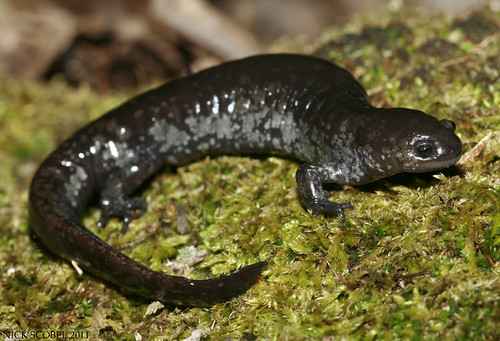
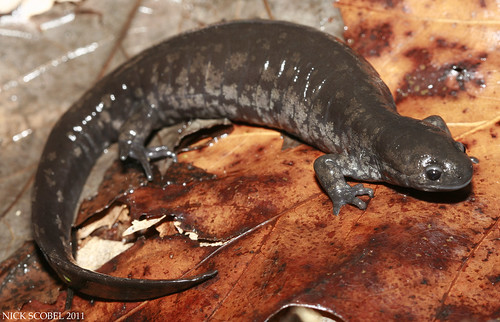
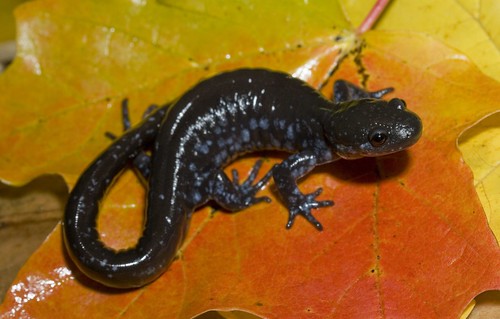
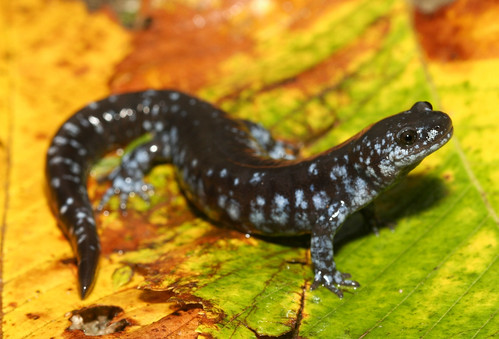
Probably our most common Mole salamander, the Blue-spotted Salamander is easily distinguished from other Michigan salamander species by its dark color and light blue flecking. Some individuals may closely resemble this species but are actually unisexual hybrids which I will cover later. This species is a denizen of a wide variety of habitats in Michigan which include upland forest, lowland forest, and even the edges of some open fields. However, they are always associated with nearby vernal pools for breeding purposes.


Unlike the spotted salamander, this species does not lay its eggs in large clumps but rather attaches a single egg to cover within a breeding pool. Although eggs may be seen in close proximity to one another, they are never in one large organized clump. Blue-spotted salamanders can be found more readily throughout the year as well. They are usually found under logs, rocks, or other sorts of cover throughout the season and especially a day or two after a rain shower.


This species is common, but salamanders are important environmental indicators due to their sensitivity to chemicals and pollution. Even common species such as the blue-spotted salamander should be reported to the Michigan Herp Atlas.

Unisexual Hybrid Salamander
Ambystoma sp.

What in the hell is this thing? A lot of salamanders in Michigan may look somewhat odd, like a weird blue-spotted salamander that seems to share characteristics with other species of Mole salamander. The identity of these oddballs is one of great complexity and many biological questions. This is a unisexual hybrid salamander, an all female complex consisting of five parent species of Mole salamander which include A. laterale, A. texanum, A. barbouri, A. tigrinum, and A. jeffersonianum. This unique group of salamanders utilizes a breeding strategy known as kleptogenesis, a method of reproduction whereby a female ‘steals’ sperm from a sympatric sexual male. The sperm is required to stimulate an egg to divide (gynogenesis) but does not fertilize the egg and may or may not contribute chromosomes to the offspring. This unique form of reproduction is thought to have originated about 5 million years ago within this unique group of salamanders.
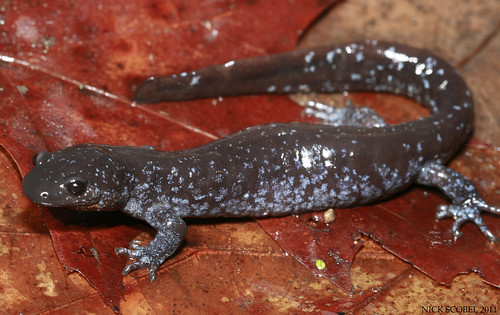

Because of their unique mode of reproduction, individuals often have more sets of chromosomes than usual. Unisexuals can be triploid (three sets), tetraploid (four sets), or even pentaploid (five sets). This occurs because of the female "stealing" genetic material from males of sexual species it shares breeding ponds with, however sperm genomes are often discarded and thus the resulting reproduction is asexual. Occasionally the sperm genome is used and passed on to the offspring. This complex mode of reproduction can result in over 20 different genomic combinations among the five contributing species. Most animals in Michigan are LLJ (laterale, laterale, jeffersonianum) or LJJ (laterale, jeffersonianum, jeffersonianum) but some may be tetraploid or pentaploid. It should be noted that the latter do not seem to do well in the wild, likely do to the unusually high amount of chromosomes.
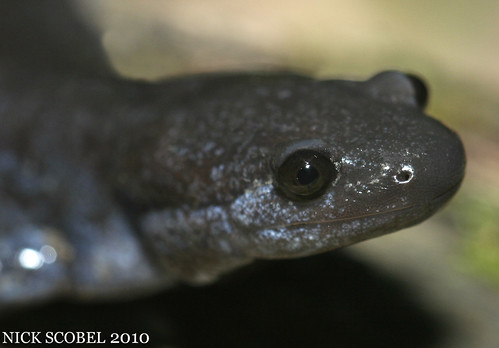

Most individuals in this group are triploid, which begs an important evolutionary question; why? There would have to be an advantage to these individuals over diploid, tetraploid, or pentaploid individuals for there to be such an abundance of this biotype over the others. Other interesting questions are also at hand, unisexuals usually share breeding ponds with contributing species but in some cases they are only found in breeding pools with the Spotted Salamander (Ambystoma maculatum). No unisexual has ever been recorded to contain genetic material from A. maculatum and unisexuals often lay infertile egg masses. Are these infertile eggs the result of the inability of the unisexuals to utilize the maculatum genome, or are the unisexuals simply using the sperm of male spotted salamanders do initiate cloning? These any many other questions are important to better understanding the origins of this unisexual complex and their presence in the Great Lakes region in the future.

Monday, February 6, 2012

Michigan's Gummy Lizards: Part One

Michigan is certainly not a hot spot for herpetofauna, especially when it comes to salamanders. Our generally flat terrain makes for a pretty low diversity of species within the state, yet we do have a few unique gummy lizards within the state lines. One such group is the Plethodontids or lungless salamanders. These salamanders breathe through their skin via a process known as cutaneous respiration, which requires the skin to be moist all the time in order for the salamander to survive. This lifestyle requires them to live in damp environments such as streams, caves, and damp woodlands. These areas abound in the Appalachians and thus the diversity of Plethodontid salamanders increases. Michigan does however hold some lungless salamander that have managed to adapt to the harsh winters of the Wolverine state.

Southern Two-lined Salamander
Eurycea cirrigera

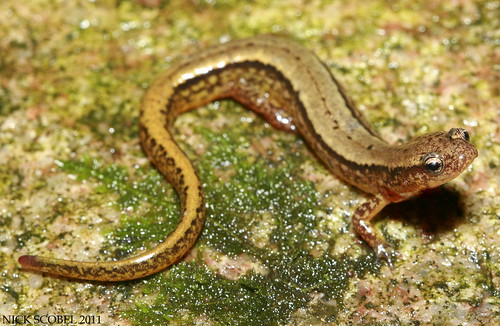
This beautiful species is one of two extremely unique species of Plethodontid salamanders which inhabit Michigan. It is easily characterized by its bright yellow coloration and two distinct dark striped running down the dorsum. The sides may be darker in appearance than the dorsum between the lines, which is often lines with small dark spots. Some individuals maybe duller in appearance than others, while some are very brightly marked.


In Michigan, the Two-lined Salamander's ecology is mostly unknown. It was discovered to inhabit a small stream only a few years ago and ongoing research is continuing to help better understand its place in the state. Genetic work determined that the Two-lined Salamanders which inhabit Michigan are the southern subspecies; Eurycea cirrigera, but as to its origin whether native or introduced is still unknown.


This roaring brook is home to the Two-lined Salamander, though its current is not usually as violent as pictured above which was due to heavy rainfall the night before. Protecting this site and continuing research on the Two-lined Salamander will help to ensure its status in Michigan for years to come. It is extremely unlikely to come across this species in the state as they are exceedingly rare and localized, but any sighting should be reported to the Michigan DNR or to the Michigan Herp Atlas.
Northern Dusky Salamander
Desmognathus fuscus

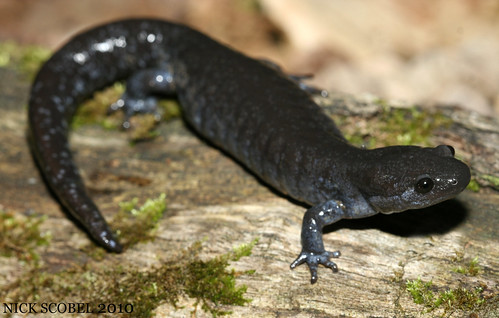
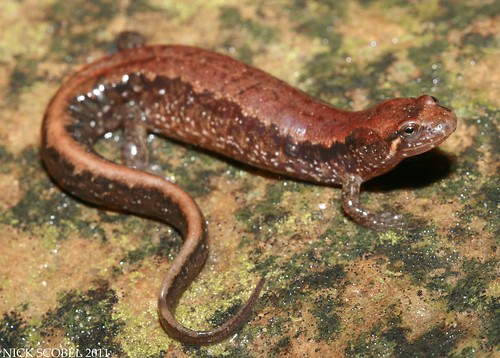
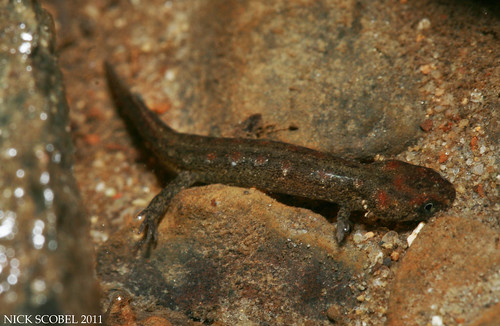
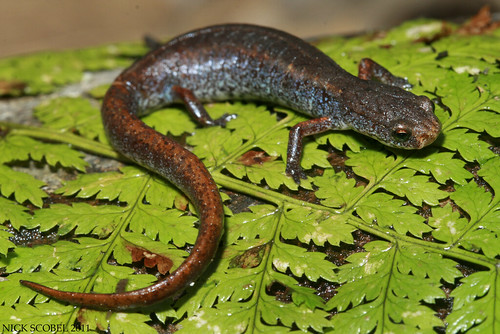
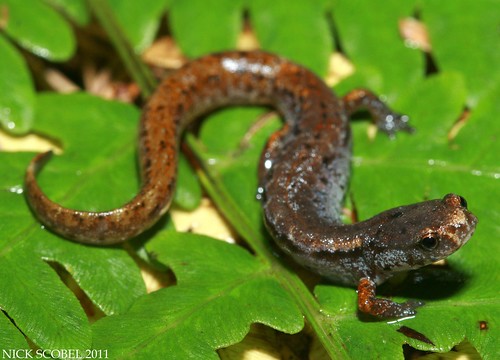
Like the Two-lined Salamander, the Northern Dusky Salamander wasn't discovered until a few years ago in Michigan. It is a robust salamander which is extremely variable in cover, with some individuals being very dark in coloration while others exhibit bright hues of red. The genus name Desmognathus, comes from the Greek words desmos and gnathos, meaning ligament and jaw respectively. This refers to the large bundle of ligaments around the jaw which gives the members of this genus a large, bulging jaw in appearance. Another distinguishing characteristic for this species is the presence of a light diagonal line which extends from the back of the eye to the corner of the jaw, it is easily visible in both of the animals shown here.


Duskies are denizens of streams, seepages, and any habitat in which a trickling water source is nearby. Like the Two-lined Salamander this species is only found at one location in Michigan, a clear stream amid a mature Eastern Hemlock forest. In the early summer, females lay eggs on the undersides of rocks, logs, leaf litter, and other forms of cover. The hatching larva are completely aquatic and have well developed gills which eventually diminish over time.


Larva like the one shown above often have traces of adult coloration and usually have 6-8 faint spots which are visible on the dorsum. They retain this characteristic as they age but eventually it becomes faint or lost altogether amongst other patterning. It is extremely unlikely to come across this species in the state as they are exceedingly rare and localized, but any sighting should be reported to the Michigan DNR or to the Michigan Herp Atlas.

Four-toed Salamander
Hemidactylium scutatum

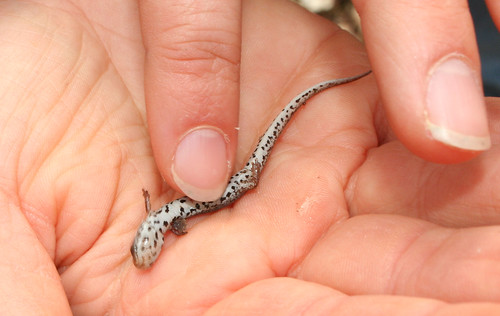
This small, secretive species is found statewide in a scattered locations where suitable habitat occurs. The Four-toed Salamander gets its name from the presence of four digits in the hind feet, while most salamander species have five digits on the hind feet. It is small in size and is generally gray in coloration with a rusty-orange tail and nose, and it may have light colored flecking along its flanks. The underside exhibits the best diagnostic character for this species, a white or cream belly with scattered black spots. There is also a noticeable constriction at the base of the tail which is not present in other Michigan salamander species which allows the Four-toed Salamander to drop its tail if necessary to avoid a predator.


Four-toed Salamanders are fairly common statewide, but may be difficult to encounter in the field as they are quite habitat specific. They are usually associated with sphagnum moss, but may also be found in and around bogs, seepages, and some vernal pools.


Females seek out sphagnum moss in the late spring and a lay a clutch of eggs within the moss and stand guard until they hatch. Though they can often be found by pulling back moss around this time, it is best to leave them be and not risk damaging eggs in the process. Though this species is likely common statewide, its current distribution within Michigan is poorly understood, so any sightings should be reported to the Michigan Herp Atlas project.

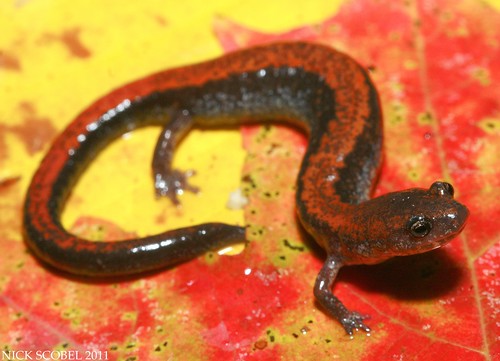
Red-backed Salamander 
Plethodon cinereus

This colorful species is by far the most common species of salamander which inhabits Michigan. It is easily characterized by the red stripe which runs down its dorsum. However, this species comes in both a "redback" and "leadback" color phase. Leadback


The reason that this species is so common statewide is because of its general habitat preference. Redbacks are almost always associated with deciduous forests which may include northern hardwoods, oak-hickory, or beech-maple forests and can be found in either uplands or lowlands. They are often found under rocks, logs, leaf litter, and other sorts of debris on the forest floor. 


Though common, the Red-backed Salamander plays a vital role in many of these forested ecosystems and shares habitat with the salamander species which will be covered in part two of this write up, the Ambystomatids. Watch for that post in the coming weeks. Until then, keep warm!

Thursday, January 19, 2012

Armed and Dangerous

One of the biggest gripes I have about my own photography is the presence of harsh shadows when I use a flash. The shadows can be unsightly and draw attention away from the rest of the photo. Below are two cases; one in which a harsh shadow is extremely prominent and a second case where it is not.


I benefitted from some nice diffuse light in the morning hours in which the bottom photo was taken. This light coupled with a flash from my Speedlite 430EX II created a nicely lit photo, but harsh shadows still exist near the feet. The top photo is absolutely terrible in my opinion, as the harsh shadow is extremely prominent and takes away from the rest of the shot. The problem with light from a single flash unit is that even when shot with a small diffuser, it is extremely direct and is going to hit the photo subject straight on and cast shadows. There are several measures that can be taken to combat this problem. Companies like Canon and Nikon make different flash systems which allow light to be fired from multiple points, such as Canon's MT-24 EX Macro Twin Flash. This adjustable flash system allows for lighting from different locations and angles and helps reduce shadows and makes for a nicely lit photograph. Nikon sells a similar model, which is wireless. Ring flash options such as the Canon MR-14EX Ring Flash create the same affect and offer better overall lighting. The one major setback to these flash systems is that they carry a heavy pricetag, ranging from $599.00 to $750.00. Instead of ditching my entire flash system, I decided to go along a different route.


This is a softbox flash diffuser made by Lumiquest. It features a 7"x9" surface which emits soft, diffused light over an area twenty-five times the size of the flash head itself, thus greatly reducing shadows and creating a nicely lit photograph. I've fired a few test shots with it and am really happy with the results so far, I just need to photograph some herps with it. It does seem to cause a loss of around 2 stops when in use, which is easily correctable using the controls on the Speedlite. I'm excited to see the results in the field come springtime and see if I can get photos out of it like this one.


This is one of the best photos I've ever taken in my opinion.The animal is in-situ and never moved a muscle and the lighting came out perfectly. I can only hope I can get some similar results once winter lets go of Michigan.

Monday, January 9, 2012

It aint over 'til its over!

November usually signals the end of herp season here in Michigan, as temps begin to dip below freezing and everything retreats below ground. In fact, the latest I've seen any sort of herp active in Michigan is mid-November. So herp activity in mid-December is completely out of the question right? On the evening of December 14th I got my answer. Temps had been relatively warm for a few days in a row (mid 40s for highs during the day) and there was a large system moving through the Midwest. The system moved right through Michigan and heavy downpours occurred the entire day of the 14th and continued into the night. The high pressure system brought moisture and also higher temperatures as the night went on, my car read 52 degrees Fahrenheit at 10:00 PM amid a heavy downpour. Conditions were perfect, so I loaded up my gear and headed out with my friend Chris to see if we could turn up any confused amphibians. We checked a few vernal pools which still had plenty of ice, so we both decided that driving roads was our best chance to intercept amphibians. Around 9:15 we had our first customer.

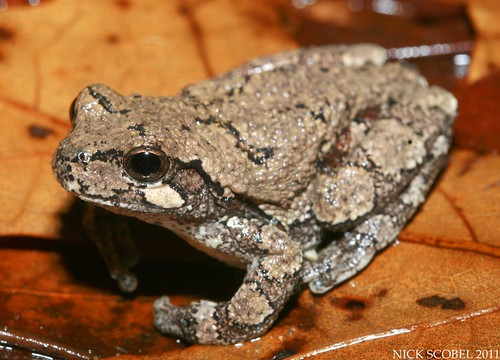
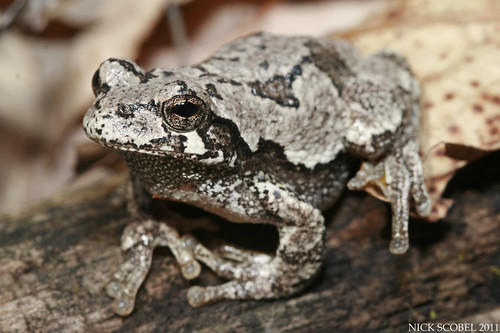
Gray Treefrog - Hyla versicolor

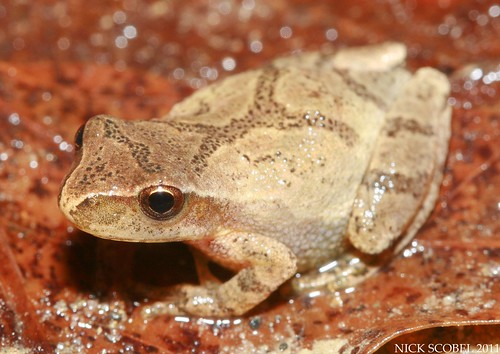
This was a good sized adult and I was a bit surprised to see this species out. I figured if anything it would have been the smaller frogs like Spring Peepers or Chorus Frogs which would be out, but I was wrong. He was quite alert, but noticeably more sluggish than usual. After a few quick shots, we parted ways. Encouraged by our success, we were elated when we saw several more treefrogs in the next half hour. In the distance, we could hear a few lone Spring Peepers calling and eventually came up on one on the road.

Spring Peeper - Pseudacris crucifer

It was clear that the frogs were out, but we were hoping we could luck into a salamander on the move as well. We were in an area which has Tiger Salamanders as well as Blue-spotted Unisexual blobs. At just after 11 PM, Chris spied this little fella on the crawl.

Unisexual Hybrid Salamander - Ambystoma sp.

It was awesome to see amphibians active this late in the year and I can't think of anytime I've seen or heard of amphibians being active in Michigan in mid-December. This is only further evidence of global climate change, causing an increase in irregular weather patterns at varying times of the year. So in this case, I owe a pat on the back to climate change.