Showing posts with label eastern fox snake coastal marsh michigan. Show all posts

Monday, February 14, 2011

The Eastern Fox Snake

Well, the sun is out and the snow is melting. But it's still a good month or so until things get rolling here in the Wolverine state. My thoughts are ahead to the emergence of Michigan's herpetofauna in the coming months, and especially to the month of May. This month seems to be a bit of a booming month when it comes to herps, and one species that I like to look for at this time of year is the Eastern Fox Snake. These large, powerful constrictors are restricted to the coastal marshes and adjacent habitats of southeast Michigan, while the western subspecies is found in the western half of the upper peninsula. This species has suffered greatly across its range due to road mortality, habitat loss, illegal collection, and intentional killing. In Michigan it's numbers have dropped so greatly that is listed as a Threatened species here.

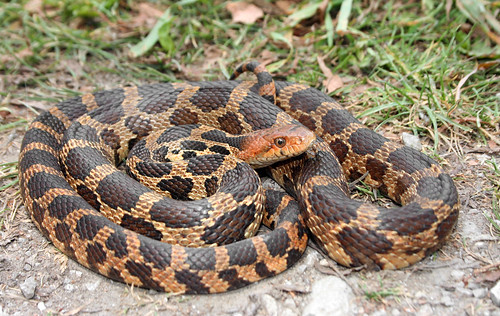
Eastern Fox Snake - Pantherophis gloydi

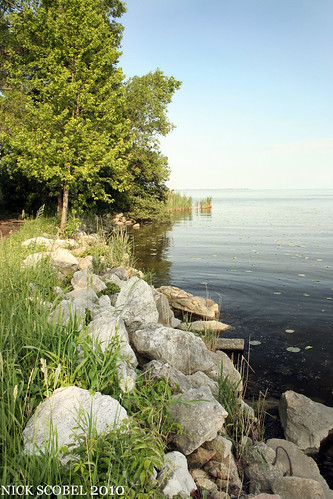
Coastal Marsh is an herbaceous wetland community occurring statewide along the shoreline of the Great Lakes and their major connecting rivers. Vegetational patterns are strongly influenced by water level fluctuations and type of coastal feature, but generally include the following: a deep marsh with submerged plants; an emergent marsh of mostly narrow-leaved species; and a sedge-dominated wet meadow that is inundated by storms. These areas are often bordered by lakeshore, or by riparian areas (rip-rap) that provides shelter for these large constrictors. A recent study done by Kile Kucher of Central Michigan University found that Eastern Fox Snakes chose rip-rap almost 80% of the time in his telemetry study on spatial ecology of the species.
 

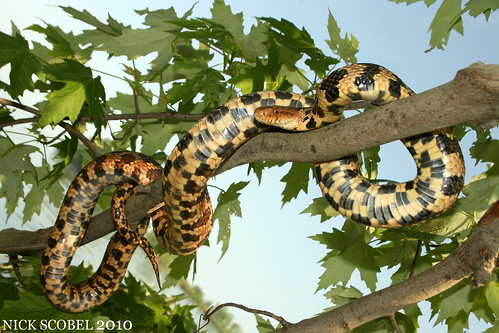
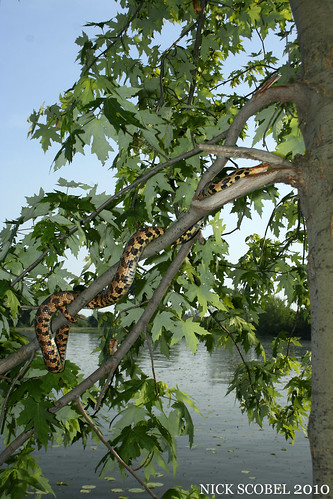
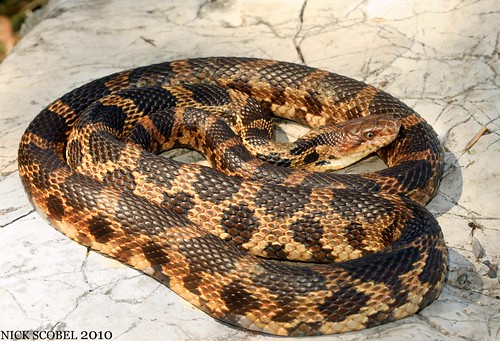
Here you can see an adult Eastern Fox Snake coiled among rip-rap while taking cover amongst some ivy on a sunny morning in June. Although Fox Snakes are large in size (3-5 feet), they can extremely difficult to find at a given time. Studies have shown that this species moves frequently and can cover great distances in a single day. Males tend to move more than females, but both sexes are extremely active snakes. They spend the majority of their time on the hunt for rodents, birds, and other snakes. At certain times of the year, Eastern Fox Snakes can be found near nesting rookeries for various shorebird species as they like to target fledglings of herons, gulls, and egrets. Although they are found at ground level, they are excellent climbers as they search for birds and other food items, such as this large individual I found scaling a tree.
They are an impressive snake to be sure, but are in constant need of constant conservation and management. Fox Snakes are often found in extremely developed areas of southeast Michigan and are often run over by motorists or killed intentionally by ignorant people who thing they are rattlesnakes. Although they do hold their ground, hiss, and vibrate their tail against leaf litter if they are cornerned, Fox Snakes are not an aggressive species would rather be left alone. If you happen to come across one in the field, leave it be and only take photographs from a distance.

Thursday, January 7, 2010

Foxy

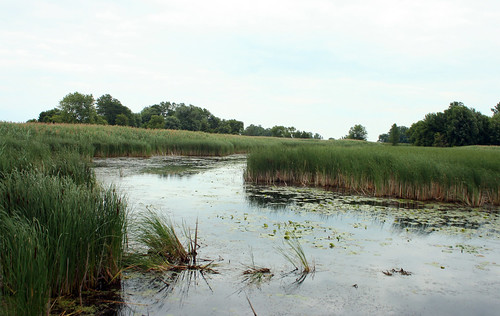
Before the beginning of the 2008 field season, I promised myself I would spend a little time looking for one of Michigan's largest snake species. The state is home to two subspecies of Fox snake; the Western Fox Snake inhabits the pine barrens of the western Upper Peninsula while the Eastern Fox Snake is found in the coastal marshes of the southeast Lower Peninsula. Not only is the Eastern Fox Snake a threatened species in Michigan, but its habitat is also one that is in need of constant management and protection. An invasive cattail known as Phragmites has choked much of these coastal marshes and outcompetes native cattails. However, some areas of coastal marsh are still in good shape and have native species still in control.


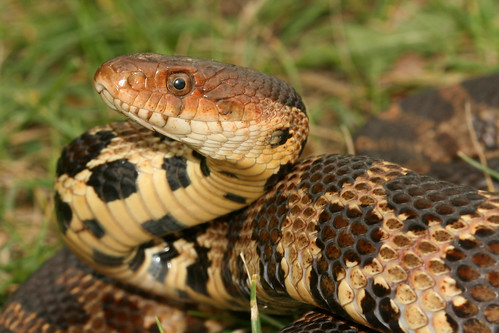
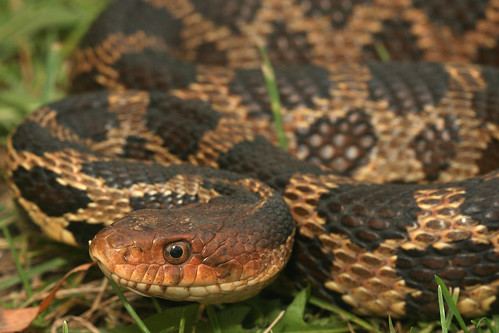
Fox snakes are one of the more attractive species in the state and their size makes them equally impressive. Several trips to the coastal marshes this summer produced severals snakes ranging from 2.5-5 feet. It was a privilege to be able to help a local herpetologist with his work on these snakes during the summer and is something I hope to do in the future.


Eastern Fox Snakes - Elaphe vulpina gloydi